
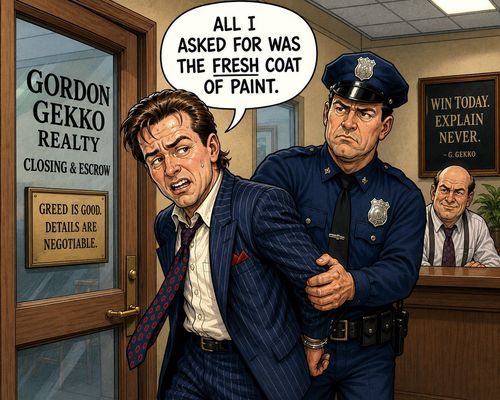
Whenever I hear the words: “Creative Financing”, my mind goes back to the last scene of the 1987 film, Wall Street. The main character played by Charlie Sheen, walks into his Manhattan office to find it filled with Federal agents waiting to arrest him for fraud and several security violations. As he’s escorted out of the build in handcuffs, Sheen begins to cry. It should be required viewing for anyone in personal finance.
But the protagonist of the story was punished because he broke the law. Fortunately, real estate offers several perfectly legitimate ways to make a transaction work for both buyer and seller. You just have to play by the rules and assure everyone understands what is happening. Two of the most common strategies are price reductions and seller concessions.
A price reduction lowers the purchase price of the property. This can help buyers who need a bit of breathing room to qualify or simply want to save some money. It’s quite common in most markets. Perhaps almost as common is that of seller concessions which leave the purchase price unchanged but shift certain closing costs from the buyer to the seller.
While both can improve affordability, a price reduction slightly lowers the monthly mortgage payment whereas concessions primar
ily help buyers with cash needed at closing. But these compromises can take many forms.
Concessions can be offered as marketing inducements or negotiated. These can range from offering a home warranty or leaving certain appliances behind, to economic allowances like buyer closing costs, HOA transfer fees or paying for loan discount points. The key is that all concessions must be properly disclosed and acceptable to the lender.
Once a property has sat on the market for several weeks with not much interest, a good Realtor® will advise the seller client to adjust the listing price preemptively to better reflect the local market and to increase foot traffic. But a price reduction may not be feasible when a buyer is short on cash at closing but still qualifies for the mortgage. When a seller is agreeable to paying some of the buyer's closing costs, it can save several thousands of dollars.
The local market often affects how willing a seller is to offer concessions. In a seller's market, where inventory is limited, concessions are generally less common. In a buyer's market, where homes are plentiful, sellers are often more willing to negotiate in order to attract qualified buyers.
One novel strategy utilizes both concepts of pricing and concessions. Where a seller may not be willing or financially able to offer a price break, a sales price could actually be raised to cover the cost of any fees given at closing. Commonly referred to as a “bump up”, it’s an approach which could make both sides happy. That is, providing the property actually appraises for the new amount. Again, this is depending on the loan type and the banks approval.
A real estate purchase is often a family’s single largest investment. It can also be a very stressful time, especially when it comes to negotiating. Frivolous requests can cause a home owner to not take the buyer seriously and tank the deal. That's why buyers and sellers alike should seek the advice of an experienced Realtor® who understands both the local market and the financing strategies available to help everyone reach the closing table.
Creative financing isn't about bending the rules. It's about working within them well enough to create solutions that benefit both parties, and without anyone being placed in handcuffs.
© 2026, Blaine Little is an author, trainer and public speaker and the Founder & CEO of Momentum Seminars Training & Coaching. We help businesses grow by investing in their people. For more on about our programs, visit www.MomentumSeminars.com
This material is an original composition and with the exception of graphics and basic editing, composed without the aid of Artificial Intelligence.